



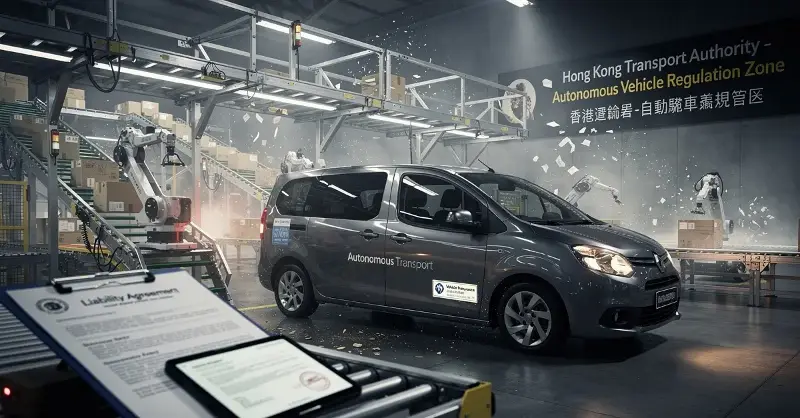
Hong Kong has provided further detail on how autonomous vehicles (AVs) and advanced driver assistance systems (ADAS) will be regulated as the city expands pilot schemes and prepares for wider commercial deployment. In a written reply to the Legislative Council on 7 October 2026, Secretary for Transport and Logistics Ms Mable Chan outlined the Government’s approach to legal liability, insurance, road safety enforcement and public education. The response follows broader efforts to expand autonomous vehicle trials as part of Hong Kong’s digital transport strategy.
According to the official Legislative Council reply, the Government said existing road traffic legislation already applies to AVs and their operators, while additional requirements have been introduced under the Road Traffic (Autonomous Vehicles) Regulation.
Existing road traffic laws apply to autonomous vehicles
The Government stated that AVs are regulated under the Road Traffic Ordinance and its subsidiary legislation in the same way as conventional vehicles. This means that vehicle registration, licensing obligations and legal liabilities for vehicle owners and operators remain in force regardless of the level of automation.
Officials clarified that the legal definition of a “driver” also extends to backup operators overseeing AVs. These individuals may be located inside the vehicle, nearby or within a remote-control facility. As a result, they can still bear legal responsibility in the event of an accident or traffic offence.
The Transport Department requires operators holding AV pilot licences to ensure vehicles remain roadworthy and that autonomous driving systems function correctly. The regulations also require operators to maintain insurance coverage, preserve operational data and report incidents involving trial vehicles.
Authorities said liability in accidents involving AVs will depend on the cause of the incident and supporting evidence. Depending on the circumstances, responsibility could rest with operators, vehicle owners or suppliers. Journey recorders installed in AVs are intended to support investigations by providing operational data.
Authorities address concerns over unapproved driver assistance systems
The Legislative Council question also raised concerns about drivers participating in the Southbound Travel for Guangdong Vehicles scheme potentially activating unapproved ADAS functions on Hong Kong roads.
The Government said all vehicles entering Hong Kong under the scheme must pass inspections at designated mainland vehicle examination centres approved by the Transport Department. Officials said applicants are informed through notices, email reminders and in-person briefings that unapproved ADAS functions must not be used in Hong Kong.
The Hong Kong Police Force is continuing to monitor traffic safety through patrols, intelligence gathering and investigation of complaints. Drivers who improperly rely on unapproved driver assistance systems could face offences such as careless or dangerous driving. Penalties may include fines, licence suspension or imprisonment.
The Transport Department added that violations involving vehicles under the Southbound Travel scheme may also lead to reports being submitted to Guangdong authorities, alongside possible suspension or revocation of travel eligibility.
Insurance arrangements under review as automation increases
Hong Kong’s current framework requires AVs to maintain third-party risk insurance under the Motor Vehicles Insurance (Third Party Risks) Ordinance. The Government said it is continuing discussions with the insurance sector as AV technology advances towards higher levels of automation where vehicles may operate without onboard backup drivers.
Officials noted that if a vehicle causes an accident while using an unauthorised ADAS function, third-party bodily injury or death would generally still be covered under statutory protections. Insurers may later seek to recover costs from the insured party if policy exclusions apply. Claims involving property damage would continue to depend on individual policy conditions and accident circumstances.
Public education and driver training to support safe adoption
The Government acknowledged concerns that some drivers may misunderstand the capabilities and limitations of ADAS technologies. Officials emphasised that Level 2 driver assistance systems still require drivers to remain attentive and prepared to take control at all times.
The Transport Department, the Hong Kong Police Force and the Road Safety Council are continuing public education campaigns through road safety bulletins, social media and updates to the Road Users’ Code. Existing written driving tests already include content related to the correct use of driver assistance systems.
The department also said it is considering incorporating relevant skills into induction and refresher courses for driving instructors. The wider regulatory approach aligns with Hong Kong’s broader investment in AI-enabled transport systems and the growing use of digital technologies in licensing and traffic management, including initiatives highlighted in the Government’s work on AI-supported transport services.
This article is created with the assistance of OpenGov AI.